AI-Generated Technical Debt: AI Code Review Before Production
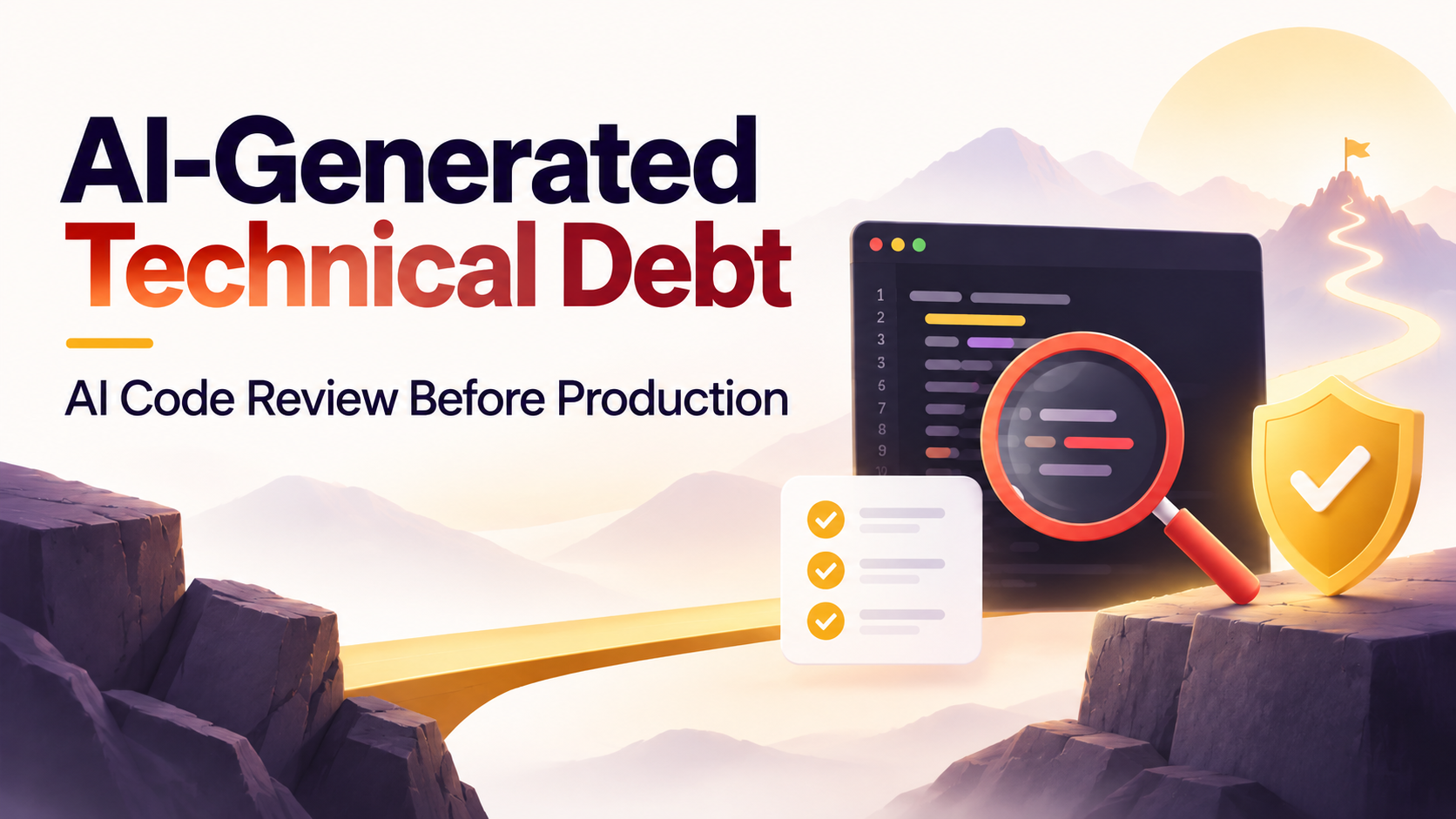
AI code review has become a billion-dollar bet, yet the industry's problem is uncomfortable: teams are asking AI to validate code that AI wrote.
On September 16, 2026, Sonar warned that self-review can inherit the same assumptions and blind spots as generation (Source).
GitHub has also expanded automated security validation for coding agents. The issue is no longer whether AI can ship code faster. It can.
The issue is whether engineering teams can detect hidden maintainability, security, dependency, and architecture debt before merge.
This guide gives CTOs and engineering leaders a practical framework to stop that debt at the pull-request boundary.
Why AI Code Review Must Detect Debt, Not Just Bugs
AI-generated technical debt is rework, risk, or structural complexity introduced by machine-generated changes that appear acceptable at merge time but become expensive after deployment. It includes duplicated logic, weak abstractions, unsafe dependencies, missing edge cases, architecture drift, and code that passes tests without matching system intent. Detection therefore requires more than syntax checks or a successful build.
Recent evidence supports stricter pre-merge controls. Veracode’s 2026 testing reported that only 55% of AI-generated tasks produced secure code under its benchmark conditions, while GitHub now applies CodeQL, dependency checks, and secret scanning to code created by supported coding agents.
The Technical-Debt Indicators Teams Should Track
| Indicator | What to detect before merge |
|---|---|
| Duplication | New helpers or services recreating existing logic |
| Complexity | Large methods, excessive branching, hidden state |
| Architecture drift | Boundary violations, direct database access, bypassed APIs |
| Dependency risk | New packages, stale versions, unnecessary libraries |
| Test weakness | Happy-path-only tests, mocked critical behavior, missing failure cases |
| Security exposure | Injection paths, secrets, unsafe auth or cryptography |
| Change inflation | A small requirement producing a disproportionately large diff |
Static code analysis catches many deterministic defects, but it cannot decide whether a new service violates domain boundaries or whether an AI-generated abstraction duplicates an internal capability.
How to Detect AI-Generated Technical Debt Before Merge
The reliable answer to how to detect AI-generated technical debt is layered verification: record where AI contributed, run deterministic security and quality checks, compare the change against repository architecture, test failure paths, and require independent human approval for high-risk changes. No single AI code reviewer should be treated as the final authority for correctness, security, and maintainability.
1. Add Provenance to Every AI-Assisted Pull Request
Quokka Labs recommends capturing provenance before evaluating quality.
Provenance checklist
Which coding assistant or agent generated or modified the change?
Which files or modules were AI-assisted?
What prompt, ticket, or specification defined expected behavior?
Were new packages, APIs, migrations, permissions, or infrastructure introduced?
Was generated code manually edited?
Did a different engineer review the final change?
Are test results and scan outputs attached to the pull request?
This turns AI involvement from invisible context into auditable engineering data.
2. Run Deterministic Gates Before Generative Review
Automated code review should begin with checks that return repeatable evidence: compilation, unit and integration tests, linting, static analysis, SAST, dependency scanning, secret scanning, and policy checks.
AI powered code review tools are useful after these gates because they can reason across intent, naming, neighboring files, and change context. They should not replace deterministic controls.
3. Apply the Quokka Labs Pre-Merge Review Rubric
Score each dimension from 0 to 2. A production-bound change should score at least 8/10, with no zero in security, correctness, or architecture.
| Dimension | 0 | 1 | 2 |
|---|---|---|---|
| Correctness | Unproven | Main path tested | Main + failure paths tested |
| Security | Known risk | Basic scans pass | Scans + threat-sensitive review pass |
| Architecture | Violates boundaries | Unclear fit | Matches approved patterns |
| Maintainability | Duplicated/complex | Acceptable | Simple, reusable, documented |
| Provenance | Unknown | Partial | AI source and review evidence recorded |
For teams using product engineering services, this rubric can become a PR template plus CI policy rather than another manual spreadsheet.
What Should an AI Review Stack Actually Contain?
An AI powered code review platform should strengthen a layered review system, not become the system itself. The practical stack is: deterministic scanners for known defects, an AI reviewer for contextual issues, tests for behavior, dependency and secret checks for supply-chain exposure, and a human reviewer for architecture and business intent. That separation reduces correlated blind spots when AI writes and reviews the same change.
AI Code Review Tools vs. Copilot-Style Review
For buyers comparing specialized review tools with Copilot-style review, evaluate control depth rather than comment volume.
| Layer | Best use |
|---|---|
| AI code reviewer | Context, intent mismatch, duplication, risky patterns |
| Static analyzers | Repeatable code-quality and security rules |
| SCA/secret scanning | Dependency and credential risk |
| CI tests | Functional and regression evidence |
| Human reviewer | Architecture, tradeoffs, business impact |
For GitHub integrations, require branch protection, mandatory checks, traceable reviewer identity, and clear treatment of bot-authored pull requests. When comparing pricing, include engineering review time and escaped-defect cost, not only license fees.
AI Code Review Security Risks That Generic Checklists Miss
AI code review for AI-generated code becomes weak when the generator and reviewer share the same assumptions. The most dangerous failures are often plausible implementations that compile, pass shallow tests, and violate an architectural or security constraint nobody encoded.
Independent review, repository-aware checks, and provenance make those failures easier to find before deployment.
That is especially important in enterprise application modernization, where generated code can accidentally preserve legacy coupling or create new integration shortcuts.
Build the Merge Gate, Not Another Review Queue
As an AI-native app development and product engineering company with 15+ years of experience, Quokka Labs approaches AI-native delivery as a governed engineering system: generation, verification, human accountability, and measurable release criteria.
Its Ai Native Engineering services and AI app development services focus on production-ready systems with security, QA, monitoring, and governance built into delivery.
The same economic principle applies to engineering automation: automation creates value only when the cost of errors, review, exceptions, and maintenance remains controlled. Quokka Labs’ workflow automation ROI framework explains how to evaluate that tradeoff.
If AI-generated pull requests are increasing faster than your review capacity, Quokka Labs can help design a pre-merge control layer combining provenance, CI gates, security checks, architecture rules, and reviewer accountability.